
-
 February 5, 2026
Please bear with me for a brief laying of the foundation - because it leads to one of those breath-catching wow moments that seems especially fitting as Lent draws near.
The story of the Presentation of Jesus in the Temple has surfaced again and again for me this past year. Once, it came as a gentle nudge toward patience - Simeon, waiting faithfully, finally holding the Christ child and recognizing the fulfillment of God’s promise before his death. Other times, it has drawn me into deeper reflection on this Joyful Mystery itself. One of my favorite insights comes from Bishop Barron, who reminds us that the Temple is the place where divinity and humanity meet - and that when Mary and Joseph presented Jesus, the glory of the Lord quite literally returned to His Temple.
Did you know that each Mystery of the Rosary has a corresponding Feast Day? This past Monday, February 2nd, was the Feast of the Presentation of the Lord. The Mass reading that day - Malachi 3:1–4 - has long been one of the most beautiful and piercing passages of Scripture for me:
“For he is like the refiner’s fire,
or like the fuller’s lye.
He will sit refining and purifying silver,
and he will purify the sons of Levi,
refining them like gold or like silver,
that they may offer due sacrifice to the Lord.”Years ago, my mom shared a story that forever changed how I hear those words.
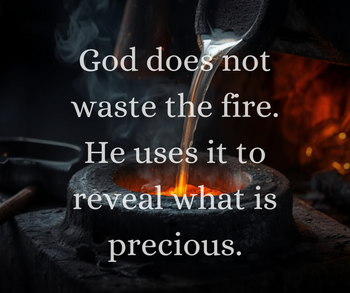
A woman walking through a season of deep trial was reading Scripture about God as the refiner and silver purified by fire. Wanting to understand more, she sought out a silversmith and asked him to explain the refining process. He told her that the purpose of the fire is to burn away impurities - and that the process requires constant, attentive watching. Too little heat, or too little time, and the silver would remain impure. Too much heat, or too long in the fire, and the silver would be destroyed.
As he spoke, the woman imagined God as that refiner - watchful, intentional, never absent. She thanked the silversmith and turned to leave, then paused and asked one final question:
“How do you know when the silver is fully purified?”
The silversmith replied simply,
“When I can see my reflection in it.”Every time I think on that final line, it undoes me. Tears well up. My throat tightens.
Because suddenly, Malachi’s words are no longer abstract. They are intimate. The fire is not punishment - it is love. God does not leave us in the flames for a moment too long. He watches. He waits. He refines until His image is reflected back.
As Lent approaches, that truth feels both sobering and hopeful: that whatever fire we are in, it is never casual, never careless - and always ordered toward the moment when we can finally offer ourselves, purified, as a gift back to the Lord.